The parts of the flute
A Native American flute has two chambers. You blow into the first; the second makes the sound. Here's the path your breath takes.
- Breath hole
- The small hole at the end you blow into.
- Slow air chamber
- The first chamber. It slows and steadies your breath. It doesn't affect the pitch.
- Plug
- Solid wood that separates the two chambers.
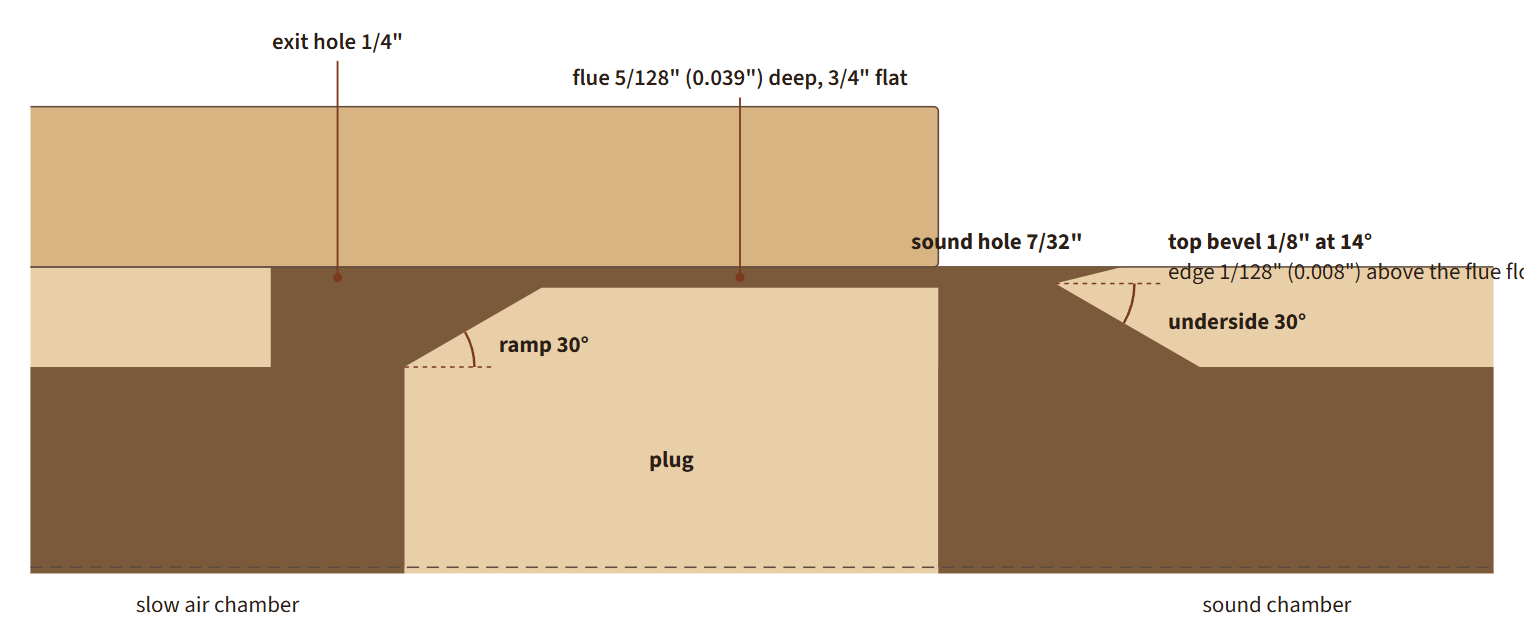
- Exit hole and ramp
- Air leaves the slow air chamber through the exit hole. The ramp is the slope on the plug that turns the air up into the flue.
- Flue
- A thin channel over the plug, covered by the block. It shapes your breath into a flat ribbon of air.
- Block (or bird)
- The piece tied on top that covers the flue. Its front edge lines up with the sound hole.
- Sound hole (TSH, "true sound hole")
- The opening where the sound is made. The air ribbon crosses it and hits the splitting edge.
- Splitting edge
- The sharp edge at the far side of the sound hole. The air flips above and below it hundreds of times a second: that is the sound. Its two bevels (top and underside) are set by angles in the calculator.
- Sound chamber
- The long chamber from the sound hole to the foot. Its length sets the lowest note.
- Finger holes
- Opening a hole makes the air column shorter, so the note goes up. Holes are numbered from the top.
- Direction holes
- A pair of holes near the foot that set the lowest note, letting the flute run a little longer for looks and tone.
- Bore
- The inside diameter of the chambers.